
If you're anything like me, you let out a joyous squeal of giddy laughter when you laid eyes upon this creature. But be warned! Though the thistledown velvet ant is incredibly adorable, their cuteness is equally matched by a painful stinger.
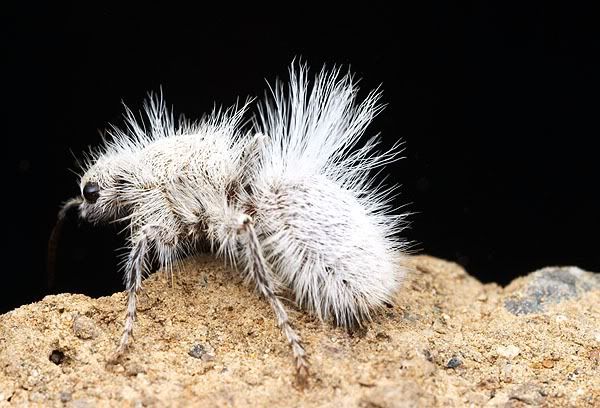 |
| Female Dasymutilla Gloriosa a.k.a. "Thistledown Velvet Ant." Photographed by Alex Wilde © 2005. |
Contrary to the name, thistledown velvet ants are actually wasps. They are solitary creatures randomly dispersed throughout the arid and semiarid climates of the Southwestern United States and Mexico. As you can tell, thistledown ants have peculiar white hairs known as setae. The setae serve an impressive purpose by mimicking the hairs found on creosote seeds. This renders the thistledown ant almost entirely camouflaged amongst the varying desert debris.
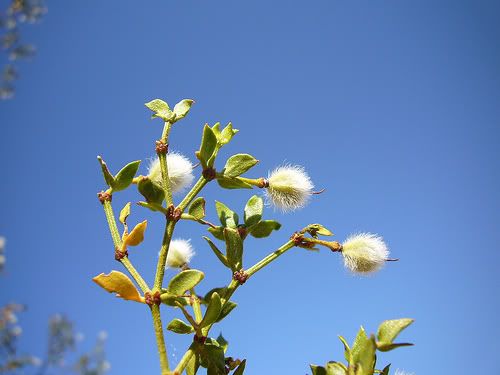 |
| Creosote seeds. Photographed by Florian Boyd © 2007. |
Female thistledown ants spend most of their time seeking out the burrows and nests of other insects. They lay one or two eggs inside each one of these neighboring cocoons, particularly those of the sand wasp. The thistledown larvae then act as external parasites and feed off of the sand wasp larvae until adulthood. However, invading other insects' homes can be dangerous work which is why they are equipped with a hard, almost impenetrable exoskeleton and a debilitating stinger. Don't worry too much though because they aren't poisonous and they'll only really effect other insects and small animals.
 |
| A closeup of a female thistledown stinger. Photographed by Alex Wilde © 2005. |
But like all wasps, males trade in their stinging abilities for wings. The males are mostly nocturnal and live out their lives seeking food and mates. But because they don’t have a stinger, they are easy catches for other nocturnal flying species such as bats and owls. To avoid detection from predators, male and female thistledown ants alike are skilled in burrowing themselves underground. On the off chance that they are caught, they let out an alarming call which sounds like a high-pitched squeak and can be distracting to predators.
Adults are primarily vegetarians and drink the nectar of various species of cactus flowers, aiding in pollination. However, it is necessary for velvet ant larvae to feed off the larvae of other insects. This means that velvet ant survival is wholly dependant on the survival and reproduction of other insects. Though they are not currently an endangered species, they are quite elusive so population densities are hard to determine and they are always fascinating to come across!
http://www.enature.com/fieldguides/detail.asp?recNum=IS0292
http://www.myrmecos.net/insects/DasyGlor1.html
http://www.myrmecos.net/insects/DasyGlor3.html
http://farm1.static.flickr.com/192/475719143_c5c0f92a82.jpg
http://bugguide.net/node/view/159/
http://insects.tamu.edu/fieldguide/cimg344.html
http://www.thegreenacresranch.com/Pages/wildlifecreatures.html
http://www.sdnhm.org/fieldguide/inverts/dasymutilla.html
Bees, Wasps, and Ants: The Indispensable Role of Hymenoptera in Gardens by Eric Grissell Pages 162-165
http://books.google.com/books?id=TO2t6OpG304C&pg=PA163&lpg=PA163&dq=thistledown+velvet+ant+limited+by&source=bl&ots=ybkyjC2Scv&sig=I1kzG-QNqZHkwNMEd-Rr9yjFboY&hl=en&ei=RdKfTPiTE4P7lwe0zdTsAg&sa=X&oi=book_result&ct=result&resnum=8&ved=0CCsQ6AEwBw#v=onepage&q=thistledown%20velvet%20ant&f=false
http://www.desertusa.com/mag01/feb/papr/ant.html
http://staffwww.fullcoll.edu/lvincent/Vinc11-99Velv.htm


