Showing posts with label sunday species. Show all posts

Sunday, October 3, 2010

Sunday Species: Thistledown Velvet Ant (Dasymutilla gloriosa)

Earlier last week whilst my fiancée and I were romping through the desert, we came across this little gal:


If you're anything like me, you let out a joyous squeal of giddy laughter when you laid eyes upon this creature. But be warned! Though the thistledown velvet ant is incredibly adorable, their cuteness is equally matched by a painful stinger.
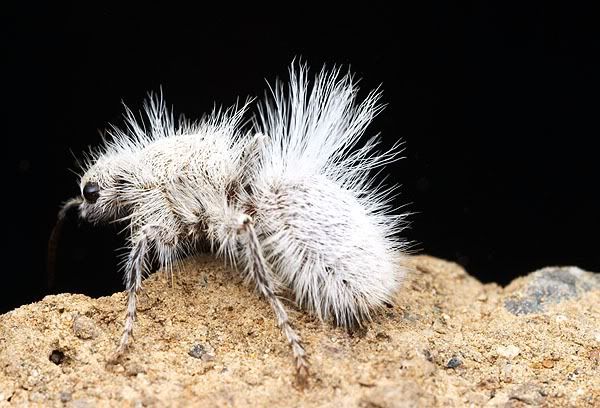
Female Dasymutilla Gloriosa a.k.a. "Thistledown Velvet Ant." Photographed by Alex Wilde © 2005.

Contrary to the name, thistledown velvet ants are actually wasps. They are solitary creatures randomly dispersed throughout the arid and semiarid climates of the Southwestern United States and Mexico. As you can tell, thistledown ants have peculiar white hairs known as setae. The setae serve an impressive purpose by mimicking the hairs found on creosote seeds. This renders the thistledown ant almost entirely camouflaged amongst the varying desert debris.
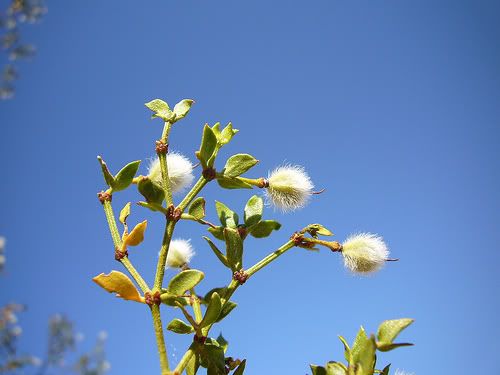
Creosote seeds. Photographed by Florian Boyd © 2007.

Female thistledown ants spend most of their time seeking out the burrows and nests of other insects. They lay one or two eggs inside each one of these neighboring cocoons, particularly those of the sand wasp. The thistledown larvae then act as external parasites and feed off of the sand wasp larvae until adulthood. However, invading other insects' homes can be dangerous work which is why they are equipped with a hard, almost impenetrable exoskeleton and a debilitating stinger. Don't worry too much though because they aren't poisonous and they'll only really effect other insects and small animals.

A closeup of a female thistledown stinger. Photographed by Alex Wilde © 2005.

But like all wasps, males trade in their stinging abilities for wings. The males are mostly nocturnal and live out their lives seeking food and mates. But because they don’t have a stinger, they are easy catches for other nocturnal flying species such as bats and owls. To avoid detection from predators, male and female thistledown ants alike are skilled in burrowing themselves underground. On the off chance that they are caught, they let out an alarming call which sounds like a high-pitched squeak and can be distracting to predators.

Adults are primarily vegetarians and drink the nectar of various species of cactus flowers, aiding in pollination. However, it is necessary for velvet ant larvae to feed off the larvae of other insects. This means that velvet ant survival is wholly dependant on the survival and reproduction of other insects. Though they are not currently an endangered species, they are quite elusive so population densities are hard to determine and they are always fascinating to come across!


http://www.enature.com/fieldguides/detail.asp?recNum=IS0292
http://www.myrmecos.net/insects/DasyGlor1.html
http://www.myrmecos.net/insects/DasyGlor3.html
http://farm1.static.flickr.com/192/475719143_c5c0f92a82.jpg
http://bugguide.net/node/view/159/
http://insects.tamu.edu/fieldguide/cimg344.html
http://www.thegreenacresranch.com/Pages/wildlifecreatures.html
http://www.sdnhm.org/fieldguide/inverts/dasymutilla.html
Bees, Wasps, and Ants: The Indispensable Role of Hymenoptera in Gardens by Eric Grissell Pages 162-165
http://books.google.com/books?id=TO2t6OpG304C&pg=PA163&lpg=PA163&dq=thistledown+velvet+ant+limited+by&source=bl&ots=ybkyjC2Scv&sig=I1kzG-QNqZHkwNMEd-Rr9yjFboY&hl=en&ei=RdKfTPiTE4P7lwe0zdTsAg&sa=X&oi=book_result&ct=result&resnum=8&ved=0CCsQ6AEwBw#v=onepage&q=thistledown%20velvet%20ant&f=false
http://www.desertusa.com/mag01/feb/papr/ant.html
http://staffwww.fullcoll.edu/lvincent/Vinc11-99Velv.htm

Sunday, July 25, 2010

Sunday Species: the Mexican Axolotl

The Mexican Axolotl has always been one of those strange creatures I've come to know and love. I even had a pet axolotl as a child. I wish I had a picture of him to share with you!

Unfortunately, the axolotl has been facing devastation from polluted waters and disease to being considered a delicacy in its homeland. Living exclusively in the Xochimilco lakes with a population of over 1500 per square mile, they have dwindled down to a staggering 25 per square mile and are now a critically endangered species.


Axolotls rarely undergo complete metamorphosis and keep their larval characteristics such as gills and dorsal fins. But these undeveloped axolotls will still live full lives anywhere from 10-15 years and grow up to a foot long. Because it is rare for them to fully develop, most of these salamanders spend their whole lives living underwater. However, some will eventually descend from the depths onto land and become full adult axolotls.

These fascinating creatures are the most studied salamanders in the world due to their regenerative abilities. This means that they can re-grow lost body parts like arms, legs, and tails. Scientists have even determined that they are able to regenerate heart and brain cells and studying the species has vastly contributed to the research of regenerative medicine.


Even Happy Aquarium supports the Axolotl!


Sunday, July 11, 2010

Sunday Species: the Apache Cicada

I apologize for the long hiatus from posting. For my absence, I decided to start a new posting schedule, one of which will introduce a new species of plant or animal every Sunday. Today, I introduce to you the Apache cicada.


Having lived in the San Francisco Bay Area for most of my life, I didn't get much interaction with cicadas. I still don't but I am definitely made aware of their presence by their buzzing. When I first moved to Palm Springs, I didn't even know they were in this territory. That buzzing I heard all the time, I simply thought was bad wiring. I remember ignorantly commenting to my fiance about how Palm Springs should really fix their electrical systems. He promptly corrected me and told me that no, those are cicadas. Today, they reminded me that they were back this summer, and in force! Driving down the street with my windows open, every tree hummed with joy.

The Diceroprocta Apache cicada lives in the southwest region of the United States. Like all typical cicadas, they live as nymphs underground and feed on roots and tree sap, only to come out once every 3-years to mate and eventually die. Here in the Sonoran Desert area, the Apache cicadas have overlapping "schedules" so are heard (but seldom seen) in the early summer every year. 

Much to many peoples' surprise, the Apache cicada is able to survive harsh temperatures out in the open by sweating the nectar it feeds on. This allows for them to have as much opportunity to mate as possible during their short adult lives. As the males buzz for hours on end throughout the day and night, the females are attracted to the sound and are able to continue the cycle of life. Then about two weeks later, the buzzing ends and we look forward to a new chorus next summer. Until next time, Apache cicada!


Picture from AmazingNature.us
http://amazingnature.us/insects/utah_cicada2.html